Syvia
The Reincarnated Demon King's Host Just Wants to Live in Peace, But the Hero Won't Leave Him AloneSyvia is the court mage whose authority binds together Theo’s childhood trauma, forced return to the capital, and public trial as the host of the reincarnated Demon King, Malthios. She is not merely an official observer: she has the power to intimidate, identify, summon, threaten, and prosecute Theo, and she repeatedly treats his independent life as an institutional problem to be corrected. Against that pressure, Theo insists that he remains a village healer first, making Syvia the clearest representative of the system that defines him by origin and danger rather than by the people he heals or protects.
Identity and Institutional Authority
Syvia appears in court mage robes and carries the visible and magical authority of the human kingdom Rizaah. When Theo steps through a portal into the capital, she meets him with cold pale-blue eyes and a pressure of mana that functions as both intimidation and a display of strength. She does not need to attack him physically to establish control; her presence makes the hall itself feel like an assertion of rank. Theo recognizes the technique and answers by holding his shoulders straight, clenching his fists, and pushing his own mana back against hers.
Her authority also includes access to the King and council. After identifying Theo as the lost healer who disappeared during Hero training, she states that she will inform the King and council that he has been apprehended. Later, she waits outside the throne room while Theo refuses the traditional red healer’s clothing she sent him, choosing his sleeveless tunic, hooded shawl, and garden-marked boots instead. His rejection of the costume is a rejection of the identity she wants displayed: Theo tells her that fine clothes will not change his fate and that he will always be a village healer first, regardless of what the authorities force him to do.
Confrontation with Theo
Syvia’s first direct exchange with the adult Theo is shaped by recognition and hostility. She opens with the accusation, “I didn’t think you’d have the nerve to show up.” Theo responds by recalling her earlier role in his life and accusing her of finding it too easy to kidnap children. Syvia replies that she had already foreseen his poor attitude when he was a child and announces that the lost healer has been apprehended. The exchange establishes their conflict as older than the immediate crisis: she sees continuity between the child she once controlled and the adult who now resists her, while Theo remembers the coercive power behind her title.
Theo’s reason for returning to the capital is not submission. Bryony and the Hero’s party come through a portal with permission to retrieve him because Luc may die, and Theo understands that entering the capital will end his autonomy. The authorities will know who he is and where he lives; Camden may recognize him; and the Hero’s party may be forced upon him again, creating the possibility that his secret will be exposed. He nevertheless goes because Luc is not expendable to him, even if the political system can replace one child with another. Syvia therefore confronts a man who has accepted institutional danger for a personal obligation, not a subject willingly reclaiming his assigned place.
Her control remains threatening even after Theo helps Luc. As Theo leaves the capital with Luc and the others, Syvia warns him to behave because the King’s will can change with the seasons. The warning converts royal policy into a continuing threat: Theo’s safety depends not on a settled judgment but on the temporary favor of those in power. His silence in response is not surrender. He grits his teeth because he is unwilling to give her another retort, while Luc keeps hold of his wrist until the capital is behind them.
Role in the Trial of Malthios’s Host
Syvia becomes the principal public voice of the trial once Theo’s identity is confirmed. The court uses a rare portal orb, broken to open a portal to the capital, and within ten minutes of Theo putting on magic-dampening handcuffs, he is taken from Leafel to the capital courtyard. Syvia orders him sent to the dungeons. The movement from village to prison is swift and administrative, demonstrating how quickly an individual life can be converted into a security procedure once the state has named its threat.
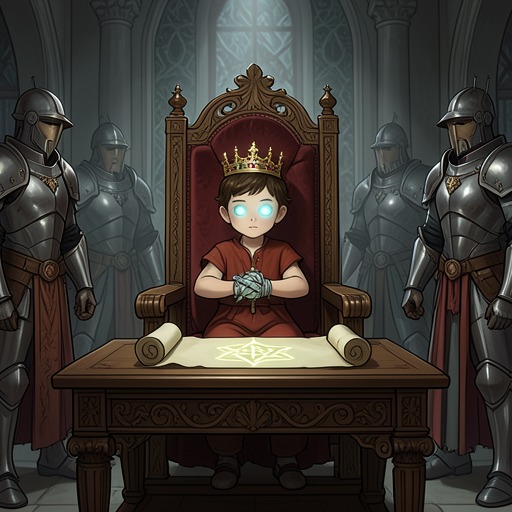
Inside the throne room, Syvia stands beside King Alexis, while Eliza’s haunting form occupies the same side of the court and the members of the Hero’s party stand opposite them. Mirror spells show the proceedings to other meeting rooms, and a round mirror above the throne broadcasts Theo’s humiliation to towns, villages, and cities across Algeya. Syvia formally opens the proceeding by announcing a trial for Healer Theo Bladefoot, revealed to be the host of the reincarnated Demon King, Malthios. The wording places the healer’s name and the demonic designation in direct collision, but the court’s reaction quickly favors condemnation: voices call for execution before the witnesses have been heard.
Syvia also challenges Theo’s account of his bond with Malthios. She asks whether the Demon King could be extracted from him and Theo freed. Theo says he did not trust the court not to kill him and explains that Malthios told him separation was impossible. When Eliza questions whether Theo believes Malthios, the exchange exposes the political problem Syvia cannot solve through procedure alone. Theo’s relationship with Malthios is not presented as a removable contamination from which the state can safely rescue him; it is an inseparable shared condition, and Theo’s own testimony gives the bond a voice the court would prefer to silence.
After the witnesses have been heard, Syvia asks the court to agree that Theo is guilty for protecting Malthios. The room assents, and she begins to move toward judgment. At that moment, Micah opens a new mirror spell from Leafel. Imani, Dale, Dmitri and his parents, Nib, Amaya, Hayden, and the people of Leafel appear behind him, demanding Theo’s release. Syvia’s courtroom consensus is interrupted by a community that refuses to accept the legal identity imposed on him. Her institutional audience has declared him guilty; his chosen community answers by naming him as someone worth defending.
Conflict with Luc and the Failure of Control
Syvia’s authority ultimately depends on the assumption that Luc will remain within the court’s understanding of duty. That assumption fails when Luc chooses Theo. After Theo’s restraints are broken, Syvia protests that Luc cannot simply let the Demon King go free. Luc answers that Theo is Malthios’s prison and that he is Theo’s humble guard, promising never to let Theo out of his sight. The statement does not deny Malthios’s danger, but it rejects Syvia’s proposed solution: Theo will not be separated from the being inside him by force, and Luc will not allow the court to treat Theo as disposable.
The confrontation leaves Syvia facing not only Theo’s resistance but also Luc’s public refusal to obey the state’s preferred moral vocabulary. She has described the situation through apprehension, guilt, extraction, and release; Luc reframes it through protection and responsibility. Her authority can put handcuffs on Theo, summon him before the throne, and command the court, but it cannot compel the loyalties that have formed outside the court’s structures. The appearance of Leafel and Luc’s decision together reveal the limit of her power: legal control can isolate a body, but it cannot guarantee that the body’s relationships will be surrendered.
Narrative Significance
Syvia functions as the recurring face of institutional suspicion surrounding Theo. Even before the trial, Theo knows that discovery would be dangerous and that friendship alone might not save him if anyone learned what he was. Cargo’s direct question about whether Theo will tell the others that he is demon spawn turns the hidden identity into an immediate social risk; Syvia represents the larger machinery behind that risk, where disclosure leads not merely to awkwardness but to confinement and a death sentence. Her presence makes Theo’s secrecy materially consequential rather than purely psychological.
Her scenes also sharpen the contrast between imposed identity and lived identity. Syvia calls him the lost healer, then presents him as the host of Malthios; Theo answers with the village healer he has chosen to become. The court sees a category requiring containment, while Leafel sees a healer, friend, and member of its community. Syvia’s cold discipline and repeated threats give the conflict its political shape, but her defeat is not a magical collapse of the court. It is the exposure of a deeper limit: the authorities can announce what Theo is, yet they cannot fully determine whom he belongs to or what obligations others will accept on his behalf.